The Studio Arts Program is available to students who wish to major in the program as well as students who wish to experience the visual arts and apply that experience to other disciplines. A successful Moderation is necessary to major in studio arts.
The Studio Arts Major
“Through Space” by Paige Eckensberger ’19
Course Components
Students are encouraged to moderate in their second semester of their sophomore year. To do this, they must have a Studio Arts adviser and either have completed or be enrolled in the following: four Studio Arts classes, including Drawing I, and one class offered by the Art History and Visual Culture Program. Transfer students who hope to moderate into Studio Arts are encouraged to contact the program early on to receive a Studio Arts adviser, and to make sure that they have the equivalent qualifying credits.
Successfully moderated students who wish to graduate must complete Junior Seminar, Senior Seminar, and a second course in Art History and Visual Culture. Additionally, moderated studio arts majors are eligible for level II and III studio classes in a variety of topics and media such as painting, drawing, sculpture, installation, extended media, digital, and printmaking. The content of each studio class and the degree of structure are up to the individual instructor. In their senior year, studio arts majors must successfully complete their Senior Project: an exhibition of original work. The exhibition is reviewed by a Senior Project board consisting of the student’s project advisor and two other faculty members.
Successfully moderated students who wish to graduate must complete Junior Seminar, Senior Seminar, and a second course in Art History and Visual Culture. Additionally, moderated studio arts majors are eligible for level II and III studio classes in a variety of topics and media such as painting, drawing, sculpture, installation, extended media, digital, and printmaking. The content of each studio class and the degree of structure are up to the individual instructor. In their senior year, studio arts majors must successfully complete their Senior Project: an exhibition of original work. The exhibition is reviewed by a Senior Project board consisting of the student’s project advisor and two other faculty members.
“Simul.” by Jules Marie Roberts ’19
Student Work
At the end of their fourth semester, moderating students present a body of work to a group of three faculty members—determined by the program and including the student’s adviser—to assess the student’s work to date, clarify strengths and weaknesses, and discuss curricular and academic goals for the rest of the student’s Bard career. All studio arts majors participate in a group exhibition of their work as part of the Moderation process.
Courses and Seminars
-
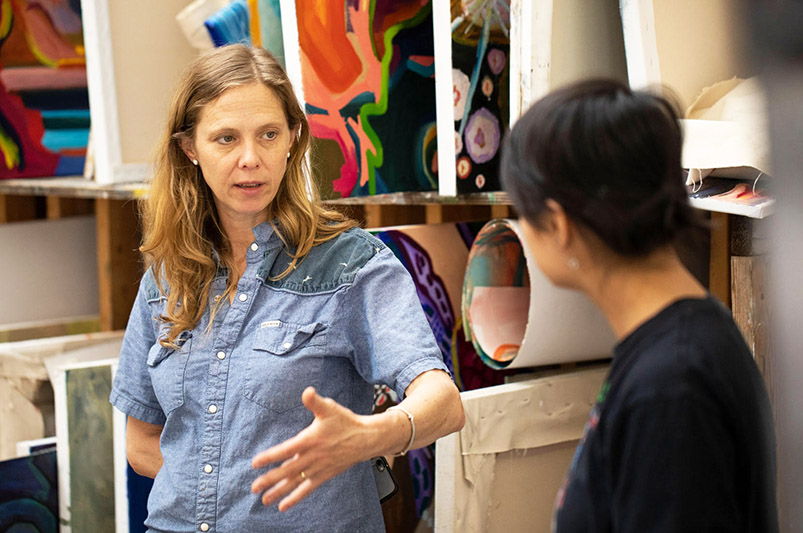 Photo by Pete Mauney ’93 MFA ’00For a complete list of courses for the upcoming semester, visit the course list website.
-
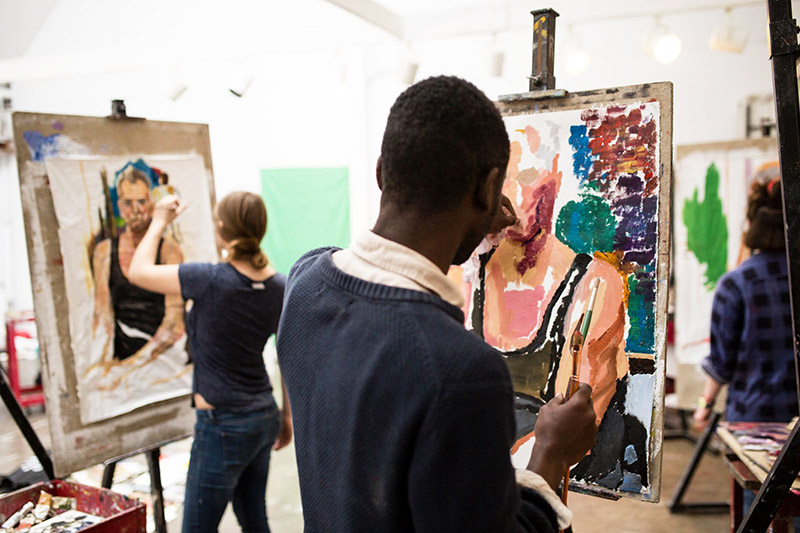 Photo by Pete Mauney ’93 MFA ’00To browse courses generally offered in Studio Arts, but not necessarily this semester, visit the College catalogue.
“Dog Eyes” by Jackson Denahy ’19
Senior Project and Exhibition
Moderated studio arts majors are eligible for the final curricular component of the program, which consists of Level III studio classes in a variety of painting, drawing, sculpture, installation, extended media, digital, and printmaking options. The Level III studios reinforce the skills and perceptions honed in the foundation courses and develop students’ abilities to execute their own projects, preparing them for work on their Senior Projects. The Senior Seminar provides a weekly forum for project critiques and discussions of student work, in which preparation of the student’s thesis exhibition is strongly stressed.
Installation by Aru Apaza ’24
Recent Senior Projects in Studio Arts
“TRYNA BE A MOUNTAIN,” Aru Apaza
“My origin in protest art making remains presently visible through my graphic use of color, text, and absurdity. I find pluralistic expansion in play and experimentation. Working interdisciplinary between sculpture, painting, and durational media, I circle through time, revisiting familiar moments through the lens of mutation in order to rewrite history. There must be a multitude of approaches if there are multitudes of truth.” Fall 2023
“Pocket Lint,” Scout Olip
“When the studio feels good, it feels like my kitchen. I have all of these materials, things I have found on the sidewalk and other things I have found; images, colors, and motifs that have come into my life. I put them next to each other.” Spring 2024
“SEDIMENTARY,” Claire Sullivan
“S E D I M E N T A R Y is a mixed-media exploration of the layers and connections between the synthetic and natural world — Where do the natural and built environments begin and end? In what ways might natural elements and man-made materials mimic or defy one another? What aesthetic, economic, or sustainable possibilities can be unearthed when nature's laws and patterns are applied to our calculated, built environment? Most importantly, how responsible must we hold ourselves and one other for our particular interactions with and impact on our environment? S E D I M E N T A R Y places the seemingly distinct worlds of the organic and plastic, along with their respective actors, in conversation with one another, in hopes of encouraging creative engagement with the protection and preservation of all life forms. Perhaps it is examining and celebrating this very exchange between nature and the artificial – with its correspondence and dissonance — that serves to lead us closer to living in greater connection with our surroundings and one another.” Fall 2023
“My origin in protest art making remains presently visible through my graphic use of color, text, and absurdity. I find pluralistic expansion in play and experimentation. Working interdisciplinary between sculpture, painting, and durational media, I circle through time, revisiting familiar moments through the lens of mutation in order to rewrite history. There must be a multitude of approaches if there are multitudes of truth.” Fall 2023
“Pocket Lint,” Scout Olip
“When the studio feels good, it feels like my kitchen. I have all of these materials, things I have found on the sidewalk and other things I have found; images, colors, and motifs that have come into my life. I put them next to each other.” Spring 2024
“SEDIMENTARY,” Claire Sullivan
“S E D I M E N T A R Y is a mixed-media exploration of the layers and connections between the synthetic and natural world — Where do the natural and built environments begin and end? In what ways might natural elements and man-made materials mimic or defy one another? What aesthetic, economic, or sustainable possibilities can be unearthed when nature's laws and patterns are applied to our calculated, built environment? Most importantly, how responsible must we hold ourselves and one other for our particular interactions with and impact on our environment? S E D I M E N T A R Y places the seemingly distinct worlds of the organic and plastic, along with their respective actors, in conversation with one another, in hopes of encouraging creative engagement with the protection and preservation of all life forms. Perhaps it is examining and celebrating this very exchange between nature and the artificial – with its correspondence and dissonance — that serves to lead us closer to living in greater connection with our surroundings and one another.” Fall 2023